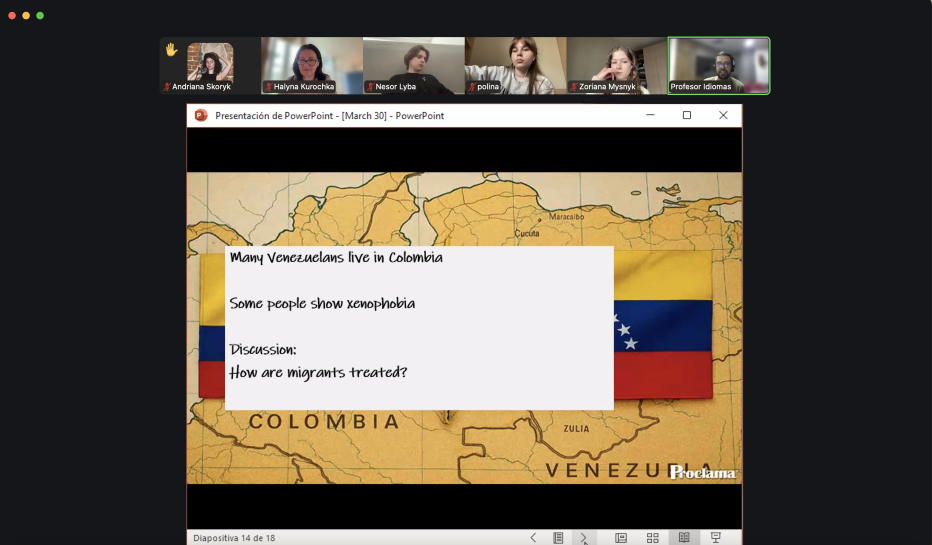
This year, together with first-year Liberal Arts students, we had a COIL (Collaborative Online International Learning) project with students from the University of Manizales in Colombia. What started as a series of discussions on history, culture, and language quickly grew into something much more meaningful.
I am especially glad that the collaboration did not end after the initial sessions. It sparked genuine interest among our Colombian partners about Ukraine, and we have continued to stay in touch, communicate, and learn from one another. Recently, we held a cross-teaching session, a “mirror class,” in which a professor from Manizales taught my students, and next week I will have the opportunity to teach his. This exchange has made the experience even more dynamic and reciprocal.
During our sessions, we explored complex and sensitive topics, including multiculturalism, interculturalism, and cross-cultural communication. Students engaged with challenging questions: Is it fair to judge people based on nationality? Are all people from one country the same? Why do people reject others? These conversations were not easy, but they were honest and necessary.
Inevitably, we also spoke about Ukraine’s current situation and the war. My students reflected on how little the world still understands, even after years of russian invasion, and how important it is to continue sharing the truth about what we are going through.
At the same time, they thoughtfully considered how to coexist with neighboring countries and how to navigate complex historical and political realities. Questions about our relationship with the aggressor country also arose, and I was truly proud to hear how mature, thoughtful, and articulate my students were in their responses.
This experience reminded me that education is not only about knowledge but also about dialogue, understanding, and the courage to speak difficult truths.
Halyna Kurochka, Head of the Center for Modern Foreign Languages